Showing posts with label Q and A. Show all posts

Friday, September 21, 2012

Barbicide Q&A | Doug Sharf


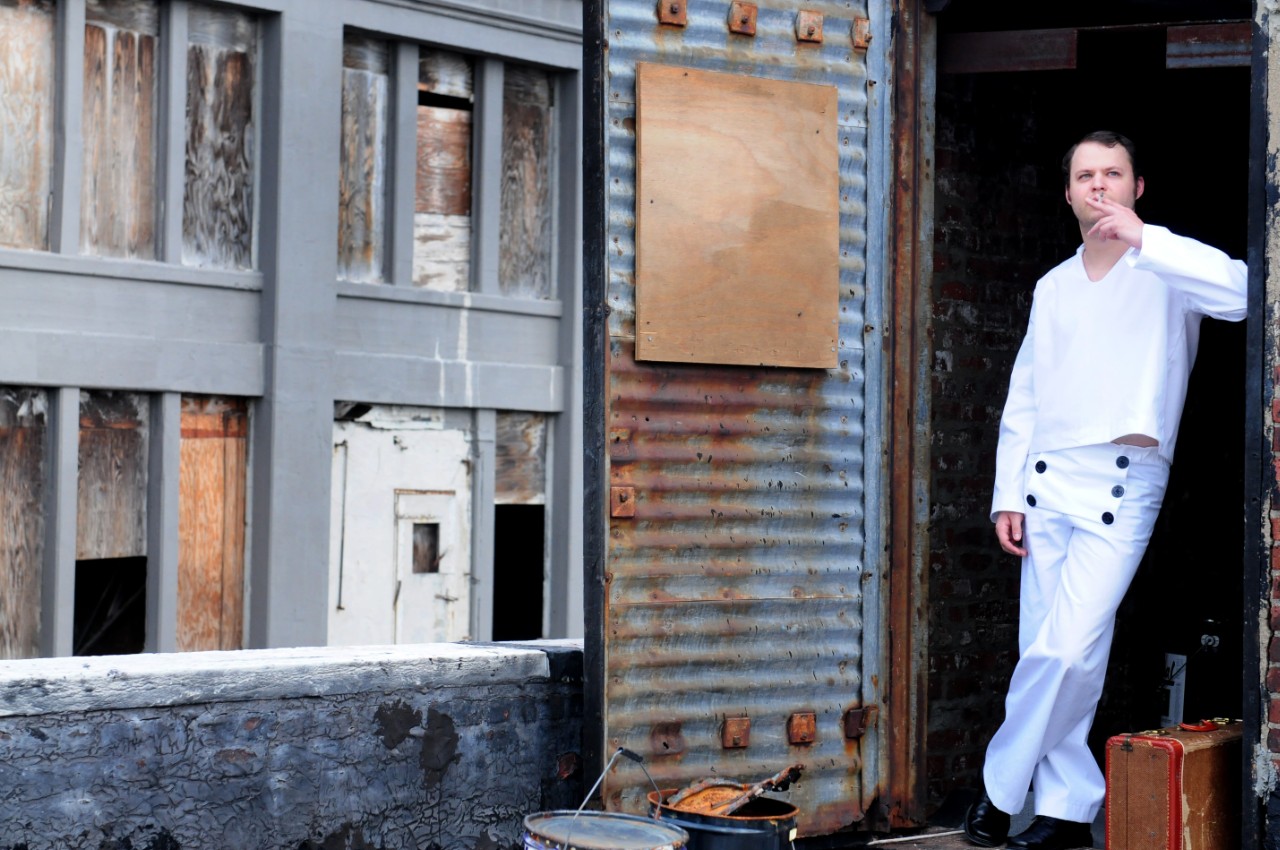
Doug Sharf portrays Ant Knee in Barbicide.
Doug Sharf, who plays Ant Knee and Toby in Barbicide,
sat down with us for a brief Q&A:


What are your characters all about?

"One of my characters, Ant Knee, is plagued with the common problem of beginning a new life after the armed forces with pretty much nothing.  The sailor boy just drifts along until he finds something worth living for: Jo.  Once he meets her, she's what he's all about.  He's not a people person and chasing a peaceful, domestic life with Jo becomes everything.  My other character, Toby, is all about eating and figuring out what happened to his role model, Joey Fanta."

Without giving anything away, What is your favorite moment in Barbicide?

"When Toddesco competes in the Shave Off."

What is the biggest discovery you have made during this production?

"Never go full retard."

 What has been one of your most memorable moments working on this piece?

"This dates back to when we started the reading series at the Moustache Tonsorial--the barber shop in the Village.  The first reading packed the place.  It was hot, there was alcohol and we had no idea how the play would be received. But it got a really strong response.  As we read through the play that night, I remember beginning to trust the words more and more because of the connection they were forming with everyone."

What is your favorite drink?

"It was Tanq+Tonic but I'm starting to just drink whiskey on the rocks. And always Guinness."

What is your favorite food?

"Pizza. From the $1 slices to the places that won't even serve just slices."

What is your current obsession?

"Writing a good script."

If you could give up one of your vices, what would it be?

"Envy, definitely. It's ugly and indicative of inner turmoil." 

What is one thing you waste too much money on?

"Food. I need to do more grocery shopping."

What is one activity you waste too much time doing?

"Fantasy Football research and watching football."

What in the world most thrills you?

"The world. Mostly travelling it. Seeing things that most other people don't get to see. Doing the more secretive stuff that the locals are into, not the tourist traps."

What is your personal motto?

"Well, my quote in my senior yearbook was from Ferris Bueller's Day Off, it was 'Life moves pretty fast.  If you don't stop and look around once in a while, you could miss it.'  I think that still applies.  It's either that or 'Never eat airport Chinese food before a flight to Puerto Rico.'"

Thursday, September 13, 2012

Barbicide Q&A | Paulette Oliva


Paulette Oliva portrays Ms. Lionetti in Barbicide
Paulette Oliva, who plays Ms. Lionetti and the Beggar Woman in Barbicide
sat down with us for a brief Q&A:


What is your character all about? 

Mrs. Lionetti, is teetering on the verge of being an "old maid" - or more appropriately in Italian -"zitella".  From a very young age - she was either babysitting for her "slow" younger brother, or working alongside her parents at their restaurant. Never married, and plodding through her dull and hapless life, she survives by operating a pizza parlor -  controlled primarily by the mob.  She escapes from her troubles at the movies, or with soap operas.  Her social life consists of driving distant aging relatives to the beauty salon.  Alone in the world, and resigned to her lot in life - things begin to spice up a bit, when a mysterious stranger enters her pizza shop.  Desparate for companionship, she concocts a storied version of past events to suit her situation.  Things begin to unravel quickly....”

Without giving anything away, What is your favorite moment in Barbicide?  

“The shave-off!”

What is the biggest discovery you have made during this production? 

With limited space, and functional props only - I am amazed how this play truly relies on the actors' ability to breathe life into every moment of this piece - to the point where an audience will not feel the least bit "under-served" in terms of production values - quite the opposite...the words seem richer, the moments are more profound, and the audience is more engaged.  The magic of theatre - period.”

What has been one of your most memorable moments working on this piece?  

I have a feeling it is yet to come.... because every time I think a moment is memorable, it gets trumped by the NEXT memorable moment.... it's about the process for me, the journey....and the collection of many memorable moments.”

What is your favorite drink? 
Grey Goose Vodka...on the rocks, no fruit, olives, or other distractions.......”

What is your favorite food? 

Potato Chips (is that a food group?)”

What is your current obsession? 

Driving with the top down.  Um, that would be my CAR top down.”

If you could give up one of your vices, what would it be?  

“I don't smoke or gamble - and Vodka's not a vice, YET.  Did I mention Potato Chips??”

What is one thing you waste too much money on? 

“Coffee at Dunkin.”

What is one activity you waste too much time doing? 

I get lost in Tumblr and Pinterest.........”

What in the world most thrills you? 

Singing "Rose's Turn" to a sold out audience.”

What is your personal motto?  

Don't wait - do it now - life is too short.”


Wednesday, September 12, 2012

Barbicide Q&A | Angie Atkinson

Angie Atkinson portrays Jo in Barbicide

Angie Atkinson, of Barbicide, sat down with The Theatre Project for a brief Q&A:

What’s your character all about?
"I love Jo.  She's this sort of sad and tough girl who's disabled but doesn't really think about it, isolated but hopeful, sheltered but wise, and adorably boy crazy.  And I love that her best friends are pigeons."
  
 Without giving anything away, What is your favorite moment in Barbicide? 
"It's hard to pick favorites, but I gotta say that I'm a huge fan of the opening scene.  It sets the tone of the play so beautifully, and I love the imagery."  

What is the biggest discovery you have made during this production? 
"I used to act a lot more often, but I switched my focus to music about a year and a half ago.  I'm loving the musician's life, but doing this piece has reminded me of how much I love acting and how much I miss doing it."  

What has been one of your most memorable moments working on this piece? 
"Christian giving Doug tips on how to be tender with women was pretty memorable."  

What is your favorite drink? 
"Ginger ale.  It's true."

What is your favorite food?
"Oh, it's like asking me to pick my favorite child!  I suppose I could probably eat tacos every day.  But, like, the delicious & fresh kind in the soft corn tortillas with the cilantro and the onions and all that.  Tacos al pastor are my favorite.  Mmmmm."

What is your current obsession? 

"I just got an Apple TV and have been streaming Magnum P.I. on NetFlix, and it is EVERYTHING.  I also kind of hope that when I die I come back as one of Adam Levine's tattoos."

If you could give up one of your vices, what would it be?  

"Eating my feelings.  It happens."

What is one thing you waste too much money on? 
"Definitely food.  I'm a starving artist so I'm pretty frugal about most things, but I'm a sucker for delicious takeout."  

What is one activity you waste too much time doing?  

"Doubting myself, 'cause any time spent doing that is wasted."  

What in the world most thrills you? 
"Music.  And meeting and connecting with other human beings, especially the ones of the cute boy variety."

 What is your personal motto? 

I often say to myself, 'One day at a time, sweet Jesus.'  And then of course, there's 'Be a strong black woman,' which is the best advice I ever got.  

Wednesday, February 22, 2012

From The Director's Notebook v.5: Branding


Developing The Brand
Building Imagery for a Production


2. 21. 2012, 4:00PM


One of my favorite pre-production projects  is creating the identity of the play I am currently working on. Some may see this a rather daunting task, for myself however, it is how I begin to give the production direction. Recently, I completed the imagery that will be used for The Theatre Project's upcoming reading of Barbicide. I thought it may be interesting to share the process that lead to the final key art that we shall be using.


When I begin to create a icon or poster for theatre, I consider all aspects. The play's setting, language, and scenic design highly influence my initial design concepts. The play may not be completely designed, and very rarely have I balanced key art when staging, but by creating this identity I can rein in all aspects.


Barbicide is a highly stylized play that hybrids beat poetry, monologues and dialogue. Linguistically it is very unique, which is why we decided to present the piece as a developmental reading prior to staging it. Additionally the play is set at the height of the 1964 World's Fair in Flushing Meadows, Queens. We see a lot of elements that will translate into the production from the time period. Even more important is the main character, Toddesco. Having been framed and imprisoned in the 1940's, and later being released in the 60s, Toddesco encounters a variety of changes to culture. All these details become a part of the knowledge incorporated into the design.
The Vanishing American Barber Shop
by Ronald S. Barlow


It was crucial that the vintage quality stay at the forefront of the piece. Both Sean Pomposello, playwright of Barbicide, and I wanted to include that dated charm. The homey quality of a barber shop has been very necessary to understand in order to develop the ideal look. I have been using a wonderful study on the tonsorial arts that really hits the nail on the head for every department. "The Vanishing American Barber Shop" has ended up becoming the dramaturg to our production. Included is the history of the tonsorial arts, old school photography, detailed product catalogs and illustrations, as well as scenic, prop and wardrobe cues. I even investigated various throwback salons in Manhattan to develop an idea of the environment we would be set in. My favorite, without any doubts, was Moustache Tonsorial. It also was important to consider that Toddesco's environment would lean more towards his past as opposed to his present, both stylistically and emotionally.


Initially, I began with a rough place-holder graphic, with the understanding that the graphic was sure to be improved upon over the course of the pre-production phase. Heavily leaning towards the more noir aspects of the production, the first try ended up being this:
First Try
I really liked the imagery. A straight razor sums the piece up perfectly while the typography calls toward a film noir style. Combining serif and sans-serif fonts was an idea that I ended up liking as well, especially for the main reason that it was done in a subtle and unobtrusive manner. The adjacent graphic did not manage to convey the play as well as I had hoped for, which led me to go a bit more vintage.


By approaching the art through a vintage approach, I opened the production up to more options scenically. Not many will use this approach, but I favor cohesion through all elements.


Second Try
The dog eared paper look in the second try really pleased me aesthetically. Additionally, the font choice felt very appropriate considering the time period that Barbicide spans.


After making these two posters, I noticed something that truly excited me. The similarity between the letter A and the straight razor was too good to pass up. Using the razor in a typographical manner had the potential to allow the show to speak for itself in a new way.


And so, I decided to do a little bit of playing around which led me me to the following piece of art work:


By combing the font from the second try with the black of the first, I was able to connect both Noir and vintage into one. And the A/razor concept ended up working out well.


Third Try

I could not help feeling that the black was too dark. Yet I did not want to lose the noir concept. I considered how that concept would be maintained through the typography as well as through staging. I then allowed myself to take what I liked out of all the concepts and fuse them together. This left me with our final product:

Fourth & Final Try
Keep in mind, that this imagery is simply for our upcoming reading. For our run this summer, we will go through this process all over again.

I must say, that the fourth try completely captures the production accurately, especially to present a reading. When it comes time for our full staging, we will have a new poster designed. Simplicity works well for a reading, but a full production's key art needs a bit more pop.


-Christian Amato

Friday, February 10, 2012

From The Director's Notebook v.4

Friday, February 10
11:30 AM

My apologies for being unable to post in the last few months, but my production schedule has been pretty hectic. Having been totally invested in B*tch, I did not have the opportunity to post as frequently as I would have liked. I imagine that those are the benefits to Twitter and Facebook. You don't have to write a lot—an update will suffice.

Currently I am working on a very cool production of Alice In Wonderland. The production is Off-Broadway at The Historic Players Theatre, and features a newly interpreted script and score by writing team Sgouros and Bell. This is the world premiere production of the musical, which features an all percussion score!

I have been fortunate to be collaborating with a large amount of artists lately, an experience which is crucial for all young directors. On Alice, I have been working with the composer and the librettist whom are both extremely keen on input and involvement. The same goes with my other collaborator, Sean Pomposello. Sean wrote B*tch and together we have been developing a new play entitled Barbicide, a noirish reflection of the Sweeny Todd myth set in 1960s Queens. To learn more about Barbicide, watch the talk balk between Sean and I.


The key to a collaboration is the level of involvement. A director should never make a bottom line. When collaborating, it is our job to guide the piece into the best possible production.

In theatre, there are a lot of opportunities to collaborate. You collaborate with actors, technicians and designers amongst others. Recently I have been able to collaborate with businesses, corporations and product lines as well.

As a director, the relationships built are equally as important in conjunction to the plays you develop. While it sounds like something you may hear in theatre school, it is a highly valuable piece of advice. It may be difficult at the outset to find collaborators you see eye to eye with, but then again not all relationships need to be on the same page in order to thrive. I am lucky to be involved with artists who share similar values as my own.

Creatives are out there, in all fields, seeking people to partner with and develop great work. Theatre allows for a fusion of many cultures and relationships. For me, I enjoy developing work with a group of people in highly varying worlds. The end result is magnificent for an audience.

Keep an eye out for future (and more frequent) posts and be sure to check out our new blog series, The Playwrights Pad.


-Christian

The director's notebook is a blog Christian Amato started through theatre projected in order to allow people to see how a younger director approaches his work.

Wednesday, February 1, 2012

Video Talk Back: Barbicide

Check out this video interview on our upcoming project, Barbicide.


Playwright Sean Pomposello answers questions with Artistic Director Christian Amato on our newest play!


Tuesday, September 27, 2011

Announcing our Cast!

We're very excited to share with all our followers our casting decisions! We have cast 5 actors to appear in both Universal Monsters and Bitch. These performers will be delving into 10 of Sean Pomposello's plays this fall and winter! They are a mighty talented bunch and we are proud to have them on board for this project! And here they are:


Michael Neithardt as Junie


Benjamin Weaver as Mitts


Brian Cheng as Davy Dollar$

Gina LeMoine as Gil

Arthur Aulisi as Uncle Knee Co

Wednesday, July 27, 2011

Q&A With Sean Pomposello


Want to learn a little bit about the man behind the plays we will be producing this upcoming 
fall? We're very excited to launch our first Q&A session with a brief interview Christian Amato had with Universal Monsters and Bitch playwright, Sean Pomposello! See what Sean had to say:


Explain yourself in 10 words or less...


People have been attempting to do that without a word count for years, without success. I’m assuming you’re referring to me as a person and not me as a writer. I did have a professor and a girlfriend, independent of one another, in the same week, refer to me as a “walking contradiction”. So, I now have a surplus of 8 words to dedicate to some other 
question. Shoot.    


Can you describe your writing style?

Well, I can—but I don’t believe anyone else would share my perspective. I often sit at my computer writing things that I’m certain will be perceived as hysterically funny only to learn, when the piece is staged, that no one else is laughing. It’s like when you see a person take a very awkward fall on the sidewalk and you suppress the urge to laugh fearing that they’ve been injured. I suppose, in my writing, I expend very little effort fighting that urge. So, darkly funny, I think, to answer the question. Also, actors don’t care for this, but I like to write a lot of lengthy monologues. 


What is Universal Monsters?

Universal Monsters is a collection of pieces I’ve written over the last few years. Thematically, they each shed light on certain unsavory aspects of our nature that we’d 
often prefer to shroud in darkness, I suppose. The shorter pieces, almost without exception, all have a confessional thread running through them; the longer ones tend to be crime dramas.


Who are your influences?

Not one writer in particular, but postwar English playwrights; writers like John Osborne and Harold Pinter. Also, Mamet, of course. Howard Korder. But, to be honest, I think my writing is more a byproduct of novels by Hubert Selby, Jr., Nelson Algren and the criminally neglected Jon Fante. At a young age, I had an uncle who was important to me who introduced me to these and a lot of the other authors who still continue to inform my writing. Beyond any particular writer, relative to form, my true playbook is Greek theater. You will often find Greek theater relies a lot on storytelling to move along the plot, with a lot of action and violence central to the story occurring off stage. You can see a great deal of this technique employed in some of my longer monologues.


Your writing is pretty aggressive. Where do you think that comes from?


I really try not to over-analyze why I write certain things, fearing that it might slow my progress as a writer. But, I think I have confronted my share of anger and violence in my life, so it is only natural that it would rear its head in my work. I grew up in the projects in the Bronx and I often joke that my first memory was having a bottle hurled at me out of a fourth floor window that struck me square in the face, resulting in quite a lot of stitches across my chin. That being my earliest memory, it should come as no surprise that violence would shape my worldview. 


What were your favorite TV shows and Movies growing up?


I was a huge All in The Family fan. To me, each episode was a little play. All other television shows paled in comparison. I grew up during the 70s—arguably the best decade in the history of movies. Certainly for someone interested in writing the kind of stories I write. I also watched a lot of movies from the 40s. My dad was a film buff and introduced me to everything from John Huston to Howard Hawks, Michael Curtiz to Anthony Mann, Nicholas Ray to Sam Fuller, and everyone in between. Film Noir, in particular, matched my sensibilities and captured my imagination. 


How do YOU begin to write a play? (Take us through your thought cycle.)


If it’s like everything else I do, not the proper way. It all begins very vaguely for me, with a subject I want to explore. For instance, a recent job working alongside some pretty fucking hideous colleagues compelled me to write it, my play that staged at The Strawberry Festival and is included in Universal Monsters. Then, I begin building characters. My action or plotting comes out of the characters. I don’t really write treatments, but I do need to know a few important details before I begin. I need to know the opening, what happens at the end of the first act, an important midway point incident, and an epiphany that occurs at the three-quarters point—an incident that reconciles the event at the end of my first act. Then, I need to have a title. If I know those, I can begin to let the story tug me along until I hit those points. If I know too much before I write the revelations don’t seem to occur very organically. That’s my process. I’m sure a professor of drama would take me to task for this approach, but for me, this works. Until it doesn’t, of course.


What should no playwright be without?

For one, a day job. It’s lunacy to put pen to paper thinking you will make a dime at it. If you’re fortunate you will get a comped ticket for your troubles, and that’s about it. Secondly, a passion for storytelling is essential. That passion will get you up before work to write. Without it you will become one with the snooze button, trust me. The last, and most important thing you should have is at least one person that believes in you. For me, it’s my wife. If you could choose, it would be good for it to be a producer with deep pockets, but failing that, a wife, a parent, a close friend—any supporter is a good supporter. Also, it never hurts to have a heavy-handed bartender that fancies you.


What's your biggest problem with today's theater?


What do I know? I’m not even sure why I write plays—there are so few that I like. Nothing I see feels real or authentic or honest. Maybe that’s the problem, all of it seems too artificial to me.


Tell us about Bitch...


Back in 2007, I opened the newspaper to read about Michael Vick, the Philadelphia Eagles   
quarterback, who was implicated in an interstate dog fighting ring that he had reportedly   operated for over 5 years. After the immediate outrage, I began to talk to anyone who would listen about this awful story. Now, I love dogs as much as the next guy, but I wasn’t sure why this story struck such a nerve. Then, after months of following the story in the papers a friend brought to my attention the fact that dogs always seem to figure prominently in my stories. A light bulb went off. Sure, there was outrage and disgust, reading these articles, but perhaps I was really just doing research for a future story. But, what kind of fool would choose to be entertained by a story about dog fighting? What kind of fool would choose to write one. I immediately put the story on ice. Months later, Michael Vick was back in the headlines. He had served 21 months in jail and was being trotted around by his agent and publicist, trying not only to repair his image, but resume his football career. These articles painted a far more sympathetic portrait of Vick. Born in Newport News, Virginia, Vick’s family lived in the Ridley Circle Homes, a public housing project in a depressed and crime-ridden neighborhood located in the East section of the port city. Apparently drive-by shootings and drugs deals were a common occurrence. In one interview Vick said he used to “go fishing even if the fish weren’t biting, just to get away” from the violence and stress of the projects. If it was the journalist’s goal to make me feel for the guy, he succeeded. I thought to myself, maybe that’s the goal of my play as well. A story about equally icky people painted in a sympathetic light. Failing that, I can always fall back making them a little darkly funny. Four weeks later, the first draft of Bitch was complete.


Any upcoming projects?

I’ve been working on another in this cycle of Bronx tales, titled Jamie Towers. It is to the Castle Hill projects of the 60s what Bitch is to dog fighting. The story concerns some dirty business that needs to be attended to before a low income housing facility gets constructed. The play will have its first reading in the Universal Monsters reading series. It's hysterically funny in the I- just-took-a-hard-fall-on-my-ass–in-front-of-a-lot-of-people sort of way.